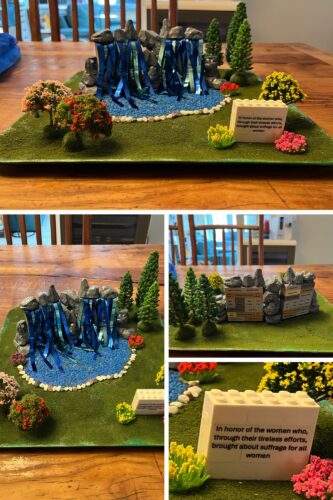
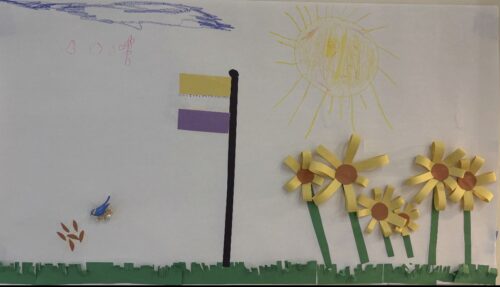
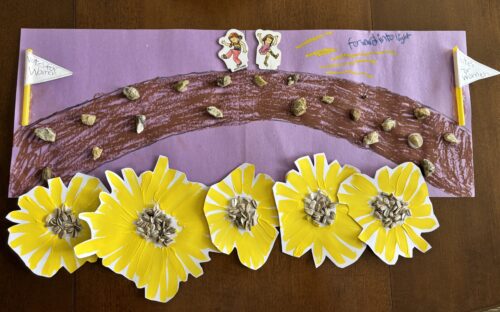
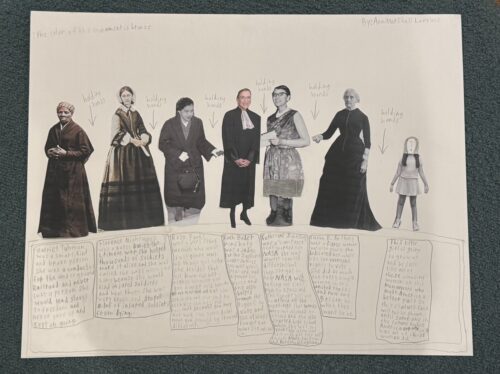
“In my seventh grade history class (Derby Academy, Hingham, MA, spring 2025), I selected to create a national monument as my final project. Below, I have excerpted from my final paper about the monument I created.
There are 40 monuments and historical sites on the National Mall in Washington, DC. There is even one honoring horses, but not a single one honoring women (NY Times). While reflecting on this project and the topics we covered this year, I found our unit on women’s suffrage very interesting, and as a female, very important to my rights. Therefore, I wanted to build a monument to honor the women who fought in the suffrage movement and the important moments over the 100 years of campaigning for women’s suffrage.
The women’s suffrage movement began in the 1820s and 1830s as part of the abolitionist movement. Women abolitionists, such as the Grimke sisters, began to push for women’s suffrage in addition to the abolition of slavery (NPS.gov). However, the first formal action towards women’s suffrage was the Seneca Falls Convention. The Seneca Falls Convention took place over July 19-20, 1848 in Seneca Falls, New York. It was organized and run by Elizabeth Cady Stanton, Lucretia Mott, Mary M’Clintock, Martha Coffin Wright, and Jane Hunt, and attracted about 300 people, even without high publicity about the event. At this convention, the Declaration of Sentiments was formed. The Declaration of Sentiments listed and described in detail all of the women’s grievances and demands. They discussed and developed 11 resolutions that all had to do with the rights of women (History.com). The 11 resolutions would undo all of the laws that said, implied, or caused women to be “less than” men. For example, they would give all women equal jobs, and the ability to have any job, without restrictions. Every one of these resolutions, except for the ninth, passed unanimously. The ninth was the most controversial, and possibly the most important, as it called for women “to secure to themselves their sacred right to the elective franchise,” which means to secure their right to vote (History.com). When this ninth resolution was voted on at the convention and passed, many women’s rights advocates decided that they no longer offered their support of the Declaration of Sentiments; however, the declaration was vital to women's suffrage as it became the foundation of the women's suffrage movement.
The movement continued after the Seneca Falls Convention, with other activists continuing to push for their rights. For example, Susan B. Anthony and Elizebeth Cady Stanton met three years later in 1851, and they then continued to work together for the next 50 years. The next big moments were the ratification of the 14th and 15th Amendments, which took place in 1867 and 1869. The 14th amendment addressed citizenship and gave all citizens equal protection under the law, and the 15th amendment gave all male citizens the right to vote (ABA). Another big moment following the ratification of the 14th and then 15th amendments took place in 1871. In the 1871 election in New York, Susan B. Anthony registered and voted for General Ulyses S. Grant. She was then arrested, tried and convicted in 1873. Her argument that the 14th amendment secured her the right to vote, however, was not successful. Shortly after this, the Supreme Court officially ruled that the 14th amendment does not give any women the right to vote, along with ruling that the women's rights were up to the states to decide. Four years later, in 1877, the Woman Suffrage Amendment was first proposed to Congress by Senator A.A. Sargant. This act was not in response to the Supreme Court ruling against Susan B. Anthony, but rather a larger scale attempt to gain the women’s right to vote. In 1916, another monumental moment took place when Jeanette Rankin was the first woman elected into the House of Representatives. Finally on August 18, 1920, four years after Jeanette Rankin’s election, and about 100 years after the movement started, women all over the nation were given the right to vote.
Not only were all of these moments and people crucial to the women's suffrage movement, but there were many activists who I have not mentioned, or who did not have their own “big moment”. I mentioned Elizabeth Cady Stanton, Lucretia Mott, Mary M’Clintock, Martha Coffin Wright, and Jane Hunt for organizing the Seneca Falls Convention and I also mentioned much of the work by Susan B. Anthony, but there are also so many more activists. For example, Alice Paul formed the Congressional Union for Woman Suffrage with Lucy Burns, which she later renamed the National Woman’s Party. She was arrested for picketing, and while she was in jail for this, she started a hunger strike. Another activist who I have not yet discussed is Ida B. Wells. She not only was an activist and leader in the women’s suffrage movement by marching and working with National American Women's Suffrage Association, but she also stood up against racial injustice along the way. She wrote a newspaper about racial injustice and the lynching of her fellow black community members (Timetoast Timelines). There are many more stories of activists that are equally important, showing just how much these women cared about and were willing to fight for their rights.
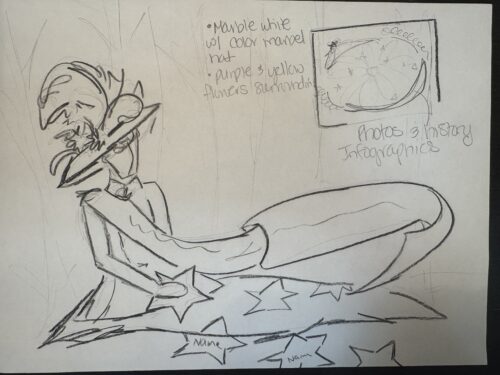
I chose the topic of the women’s suffrage movement for many reasons. The first of which is that I think with all of the other units and topics we cover, we do not have enough time to go deep into the history of the movement other than each studying an activist. Therefore, I wanted to learn more about the full history of the movement, including moments such as the Seneca Falls Convention. Another reason is that many of the topics we focus on in class, and most of American history, center around men. I found this topic that centered around women and their rights very interesting and inspiring. After I researched this topic, I realized that there was close to no representation of these women, and that the women and this movement had done so much to deserve representation. Therefore, I wanted to use all that I learned to design a monument to represent the work that the women involved in this movement put in. In my monument, I have designed a pond and a waterfall flowing into it to represent Seneca Falls, New York/the Seneca Falls Convention. The plants around the pond would be native plants to that region of New York. The rocks that build the waterfall will each have a name inscribed on them to stand for a woman who was important in the journey for women's suffrage. In my model of the monument, I was not able to include all of the names on the rocks, but if it were to be built, I have a list of all the names I would recommend for inclusion. Finally, I would place my monument at the National Mall in Washington, DC. When President Biden was still in office, one of his last actions was to sign an act for a women’s suffrage monument to be placed in the National Mall.”
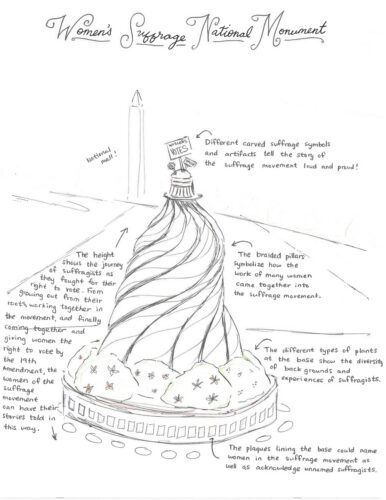
“The braided pillars symbolize how the work of many women came together in the suffrage movement.”
Monumental News!
You’re invited to inspire America’s newest landmark. We want to hear from YOU! Contribute your ideas today and have a voice in the design of the Women's Suffrage National Monument.