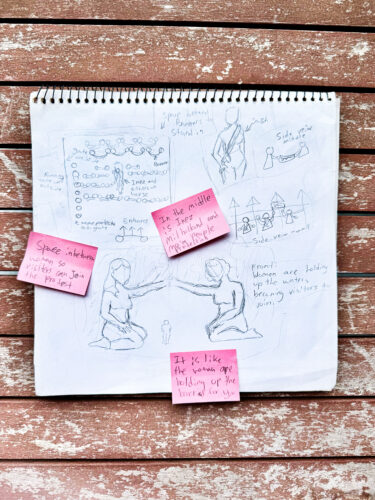
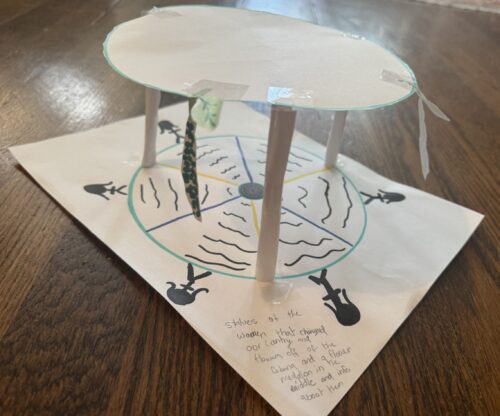
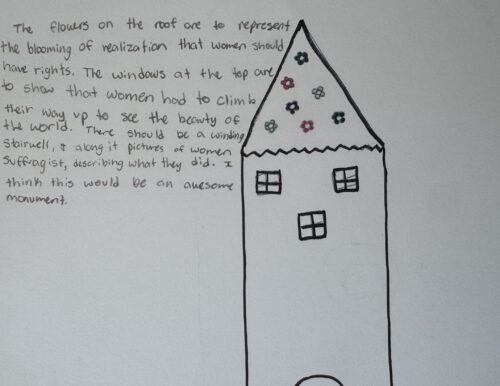
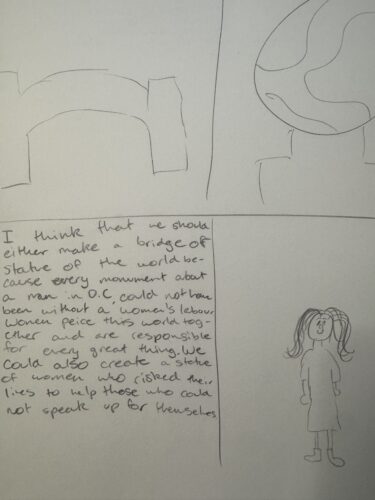
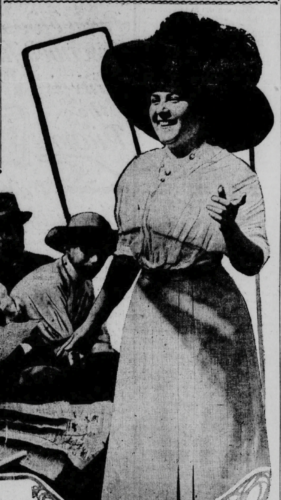
“Unveiling LA – María de Guadalupe Evangelina López This monument nomination honors María de Guadalupe Evangelina López, the first woman known to deliver public suffrage speeches in Spanish in California—a pioneering educator, activist, translator, and civic leader whose extraordinary contributions changed the course of American democracy. Yet despite helping secure one of the closest victories in the history of American women’s suffrage, María de Guadalupe Evangelina López remains virtually unknown today. The proposed monument design would be a statue based on this wonderful photo of her dressed gaily and speaking to a male audience. Surrounding the statue would be a creative stainless steel presentation of the astonishing number of news articles that were about her work and causes, incorporating artistic Mexican and California Mission elements. Long before women won the right to vote nationally, María was already breaking barriers. In 1902, she became the youngest professor—and the first Latina professor—at UCLA (then called the Los Angeles State Normal School), eventually teaching at Los Angeles High School and USC as well. In 1911, she was elected president of the College Equal Suffrage League of Los Angeles, placing her at the forefront of California's campaign for women's voting rights. In February 1911, California announced a special October election to vote on Proposition 4, the proposed state constitutional amendment providing women the right to vote. María dedicated herself to the intense nine-month campaign that followed. Recognizing that the movement had largely overlooked Spanish-speaking Californians, she translated campaign literature into Spanish, wrote original suffrage materials, and traveled throughout Southern California distributing more than 50,000 pamphlets and posters while delivering speeches in both English and Spanish. She also authored a powerful editorial in the Los Angeles Herald, arguing that California could not truly call itself a democracy while denying political rights to half its citizens. On October 3, 1911, one week before the election, María stood before a crowd at La Plaza de Los Angeles, the historic birthplace of the city, and delivered a powerful suffrage address in Spanish—the language of a community the movement had too often ignored. Seven days later, on October 10, 1911, California became the sixth state in the nation to grant women the right to vote, nearly a decade before ratification of the Nineteenth Amendment. The victory was astonishingly close. Proposition 4 passed by only 3,587 votes—roughly one additional vote per precinct statewide. Historians have long noted that the decisive margin came from California's rural counties, precisely the communities where María López had tirelessly communicated the message of suffrage in Spanish. Her work helped ensure that thousands of Californians could participate in a movement that had previously failed to speak their language. María was considered by Los Angeles suffrage leaders as a representative for California at the 1913 Woman Suffrage Procession organized by Alice Paul in Washington, D.C., although it is not known if she attended the historic event. María's public service did not end with the suffrage victory. The following year she translated ballot materials supporting labor initiatives into Spanish so working-class voters could better understand the issues before them and participate in the political process. She also advocated for women's representation on Los Angeles' all-male Board of Education and helped establish adult evening schools while teaching English to immigrant communities. Then the First World War transformed her path once again. Fluent in three languages, María left her teaching position and traveled to New York to study automobile mechanics and aviation. She was soon shipped to France with the Women's Overseas Hospitals, a volunteer organization sponsored by the National American Woman Suffrage Association. In June 1918, the French château-hospital where she was stationed came under heavy enemy artillery fire. Throughout the night, María and three fellow American women carried the wounded soldiers to safety despite the bombardment. For their extraordinary courage, the French government awarded all four women decorations for bravery. Returning to Los Angeles after the war, María devoted the rest of her life to education, civic engagement, and cultural preservation. She helped establish women's clubs and community organizations, preserved California's Spanish and Mexican heritage, and welcomed scholars, artists, and civic leaders to her family's historic adobe near Mission San Gabriel, creating a living bridge between California's past and future. She later married linguistics professor Hugh Lowther of Occidental College, shared his passion for international travel, and continued teaching Spanish language and literature at both USC and UCLA. In 1937, she became president of the UCLA Faculty Women's Club. María de Guadalupe Evangelina López died on November 20, 1977, at the age of ninety-six, having lived long enough to witness many of the social and political changes she helped set in motion. Her legacy deserves lasting public recognition. She gave the first known public suffrage speech in Spanish in California. She helped secure voting rights for California women. She risked her life rescuing wounded soldiers during World War I and was honored by France for her bravery. She devoted nearly a century to teaching, translating, preserving culture, and building stronger communities. Yet there is no bench nor building at UCLA with her name on it, no statue of her in La Plaza de Los Angeles. Our proposed monument seeks to ensure that future generations know her name and understand that democracy has always depended upon those willing to expand its promise.”
This monument is inspired by María López's own words, published in the Los Angeles Herald during the 1911 California suffrage campaign:
"A democracy we have been taught for many a year is a government of the people, for the people and by the people...Since woman is a human being and has a soul, she is a person—man is a person. Therefore man and woman both being persons are equal. Man and woman constitute the people. Can we have a democracy without man? No... Can we have a democracy without woman? No... because they are persons... and together they complete that great institution, the people—hence the democracy.”
Her philosophy extended beyond politics. In a 1912 LA Herald interview titled "Take Time to Love, Says Don's Daughter," María reflected that meaningful change begins with human connection and compassion:
"It makes anyone happier to hear an expression of appreciation for work well done, of sympathy for pleasures genuinely enjoyed.”
When asked whether a committed suffragist could also embrace romance and sentiment, her answer revealed the humanity that made her such a persuasive advocate:
"Can any woman work less well because she loves more?... Each life would be fuller, work would be better, and the women of today would grow old with more grace if the sentiment were spoken.”
María’s call to serve led her from political campaigns to WW1 battlefields. She shared with the LA Times:
“It’s just a chance whether I’ll ever return, but I am ready and willing to make the sacrifice for my country. I have no one depending upon me and my country needs me, so I must go. The idea of flying and going to France thrills me. The call cannot come too soon even if before I have finished my course in flying. I’m anxious to give my service and to be doing something for my country.”
These words remind us that María López fought not simply for political equality, but for a more humane and inclusive democracy—one grounded in service, empathy, and the recognition of every person's full humanity.
Featured Submissions
Lanaro
Ann Marshall
Sloane