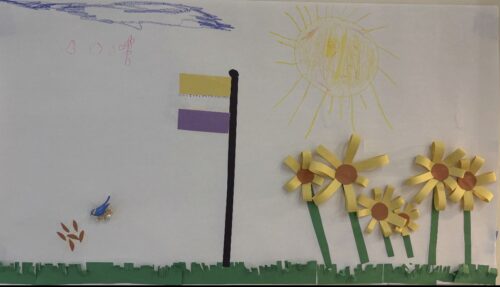
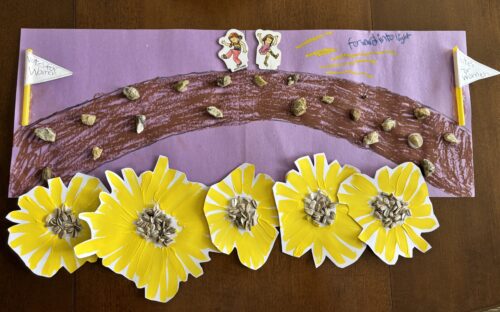
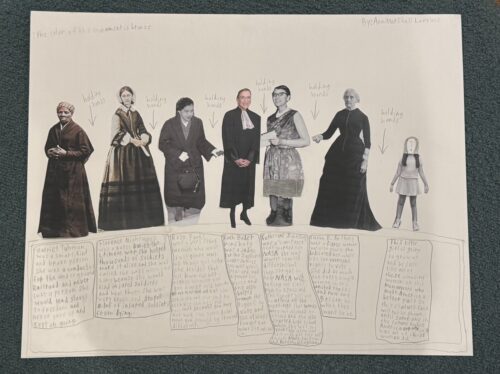
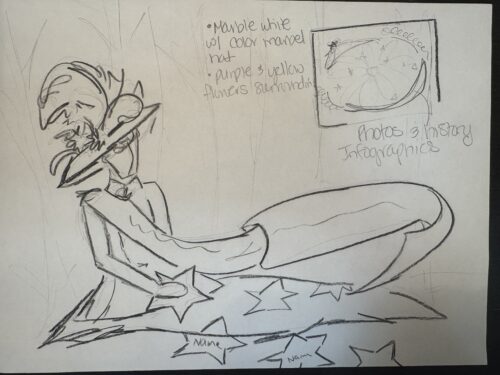
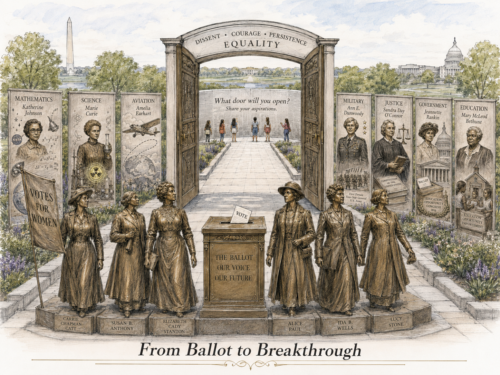
“Title: From Ballot to Breakthrough My proposal for the Women’s Suffrage National Monument is titled *From Ballot to Breakthrough*. This monument would honor the women who fought for the right to vote while also showing that suffrage was not the end of the story. It was the beginning of new opportunities for women to use their voices, lead in public life, and break barriers in fields where they had once been excluded. The monument would begin with a group of prominent suffragists positioned at the entrance, including Carrie Chapman Catt, Susan B. Anthony, Elizabeth Cady Stanton, Alice Paul, Ida B. Wells, and Lucy Stone. These women would represent the courage, persistence, and determination required to change American democracy. They would lead visitors toward a central ballot box, which would symbolize far more than a vote. It would represent women’s citizenship, political voice, and rightful place in shaping the future of the nation. Directly beyond the ballot box would stand a large open archway engraved with the words *Dissent, Courage, Persistence,* and *Equality*. The archway would symbolize the barriers women broke through and the doors that opened because of the suffrage movement. Visitors would walk through the arch and continue along a pathway lined with panels honoring pioneering women in major fields of achievement. Each panel would highlight one field and one woman whose legacy reflects the opportunities made possible by expanded rights and representation. The mathematics panel would honor Katherine Johnson, whose calculations at NASA helped send astronauts safely into space. The science panel would honor Marie Curie, whose research on radioactivity transformed modern science and medicine. The aviation panel would honor Amelia Earhart, whose solo transatlantic flight inspired women to imagine themselves in fields once dominated by men. The military panel would honor Ann E. Dunwoody, the first woman to become a four-star general in United States military history. The justice panel would honor Sandra Day O’Connor, the first woman to serve on the United States Supreme Court. The government panel would honor Jeannette Rankin, the first woman elected to the United States Congress. The education panel would honor Mary McLeod Bethune, whose work expanded educational opportunity and advocacy for African American students. These panels would show that women’s suffrage was not only about gaining access to the ballot box. It was about opening the path to leadership, service, discovery, justice, and education. The monument would help visitors understand that when women gained a stronger voice in democracy, the entire nation benefited from their talent, knowledge, and leadership. At the end of the pathway, the monument would feature a reflection wall inviting young girls to share their aspirations. This space would ask the question, “What door will you open?” The reflection wall would connect past, present, and future by reminding visitors that the work of equality is still ongoing. It would encourage young women to see themselves as future leaders, innovators, public servants, educators, scientists, and changemakers. The central message of *From Ballot to Breakthrough* is that the fight for women’s suffrage was about more than a single political right. It was about voice, opportunity, equality, and the power to shape history. This monument would honor the suffragists who fought for the vote, the pioneers who walked through the doors that suffrage helped open, and the young girls who will continue opening doors for future generations.”
The words that inspired me most were **“What door will you open?”** I think this phrase connects the past, present, and future of women’s history. The suffragists fought to open the door to voting rights, but their work also helped open doors for women in government, education, science, medicine, law, aviation, math, and the military.
I was inspired by the stories of women who refused to accept that their voices or talents did not matter. Suffragists like Susan B. Anthony, Ida B. Wells, Alice Paul, and Lucy Stone fought for political rights even when they faced criticism and resistance. Their courage helped make it possible for later pioneers, such as Katherine Johnson, Sandra Day O’Connor, Jeannette Rankin, Mary McLeod Bethune, Amelia Earhart, Marie Curie, and Ann E. Dunwoody, to break barriers in their own fields.
To me, this monument should tell the story of women who did not simply ask for a place in history. They claimed it. Their stories inspired me to think about how one generation’s courage can create opportunities for the next. The phrase **“From Ballot to Breakthrough”** inspired my idea because it shows that the vote was not just an ending. It was the beginning of women using their voices to change the nation.
Featured Submissions
Leslie
Graham
Diane
Sloane